Sunday, April 10, 2016

Sandplay!

Children have always been intrigued by sand play. They dig in sand, sift it, build with it, pour it, enjoy the feel and smell of it, pretend with it, and explore how it moves. Balke (1997) contends that, "The culture of children is threatened by mass media and overproduction of plastic playthings that are ready-made and demand nothing of the child" (p. 358). Sand, on the other hand, is well-suited to the explorative and imaginative nature of young children.

Sand play promotes physical development. Large muscle skills develop as children dig, pour, sift, scoop, and clean up spills with brush and dustpan. Eye-hand coordination and small muscle control improve as children learn to manipulate sand accessories.

Sand play also promotes social skills. When children work together at the sand table they are faced with real problems that require sharing, compromising, and negotiating. A group may engage in dramatic play as they 'cook', construct roadways, dig tunnels, or create a zoo for rubber animals. As children take on roles associated with their dramatic play, they learn important social skills such as empathy and perspective taking.


Mathematical concepts can be developed during sand play by providing children with measuring spoons and cups, containers in a variety of sizes and shapes, balance scales, or counting bears. As you observe children's sand play, use mathematical terms like more/less; many/few; empty/full; heavy/light. Then challenge children to count how many scoops it takes to fill a container. Sequence accessories by size.


Children have a natural affinity for sand play. Interest can be built by providing children with inviting props, asking appropriate questions, and scheduling ample time for children to work through their play ideas. While stimulating environment is provided to enhance concept development and skill building, it is important that the sand play area remain free and child-centered so that children may generate their own play schemes imaginatively.


Tuesday, March 8, 2016

There is never an ending for fun!

Play shouldn’t always be seen as an extracurricular, optional activity, but rather an essential tool in a child’s development. Research shows that outdoor free play gives kids many valuable benefits, including the development of physical, emotional, social and cognitive skills.

Benefits of Active Play

All children should be encouraged to participate in regular active play everyday. Regular active play helps children to develop a lifelong habit of daily exercise and life skills such as:
  • -communication and social skills
  • -an understanding of social rules
  • -friendships
  • -a sense of 'give and take'
  • -patience and perseverance
  • -an understanding of others
  • -teamwork and a sense of belonging.

Keiran and Javier decided to play with the coloured balls.

Andrei fell while playing with the jumping sack. However, he laughed about it and continued playing.

Keiran having fun time playing with the over arm throw.

See Ching is playing with the bubbles.

Andrei and See Ching are playing with bubbles by the pool to excite the K1 children.

Lucas, Keiran and Enzo are having fun!
One for all, all for one!

Keiran had the ball bounced back on him and he laughed at it.

Let's all have fun!

Your role when playing with your child

It's helpful to allow your child to lead during play. Let your child determine what to do and how to do it within the limits of safety and time constraints. This lets the child try out his/her judgment and allows him/her to show you what the he/she is delighted in.

Join in your child's play, but only when invited to do so. As he/she lets you into his/her world of make-believe, give the child complete control. In real life, you may be in charge, but this is his/her world.

The attention you show your child when you play together is key to building his/her self-esteem. For example, when you pretend along with your child, you're showing him/her that you accept his/her make-believe world and that it is fun and important to you, too. Wish you a great time playing with your child!

Monday, February 29, 2016

Family Portrait


 Creative Expression is one of their favourite activities as the children get to explore with a variety of materials.  They also have opportunities to work with a few skills such as cutting with scissors, pasting, drawing etc. With this month's theme on Family, the children created their own family portrait using the materials given. They can be seen to be really enjoying the whole process.  Let's take a look at how focus they are and on their creativity!

Pasting using white glue was a breeze for the children.


Decision making takes place when a variety of materials are spoilt for choices.

Skills such as cutting using scissors are picked up as they created their family portrait.

Cutting using scissors require lots of focus.


It is always a satisfaction when a child is able to accomplish what they have in mind through Creative Expression!

Sunday, February 28, 2016

Letter A!

Children learnt about the letter "a" and its phonetic sound. To reinforce their understanding, they were asked to name objects/ things that begins with the letter "a". Children were able to name "apple", "aeroplane" and "arrow"!
 
To further enhance their understanding on the letter, they were encouraged to color the apple and ant.
 
Way to go, children!


Shaving cream painting


'Messy' and 'fun'

Two words that children love to hear together and this activity is just that, but it also resulted in a very cool, very original patterned piece of art.


What do we need?
1.Clear glue
2. primary colour paint
3. shaving foam
4. paint brushes
5. cups
  
  First we fill up half cup of glue and paint. 
 
Next, children will get to spray the shaving foam in the cup with teachers guidance and they take turns to stir the mixture together.
 "Miss Shabana! Miss Cynthia! This look like milkshake!"
 
Through this activity children get to experience the dabbing techniques to paint instead of stroking. They were also encouraged to think out of box on how they can use this technique to paint their family portrait.


Sunday, February 21, 2016

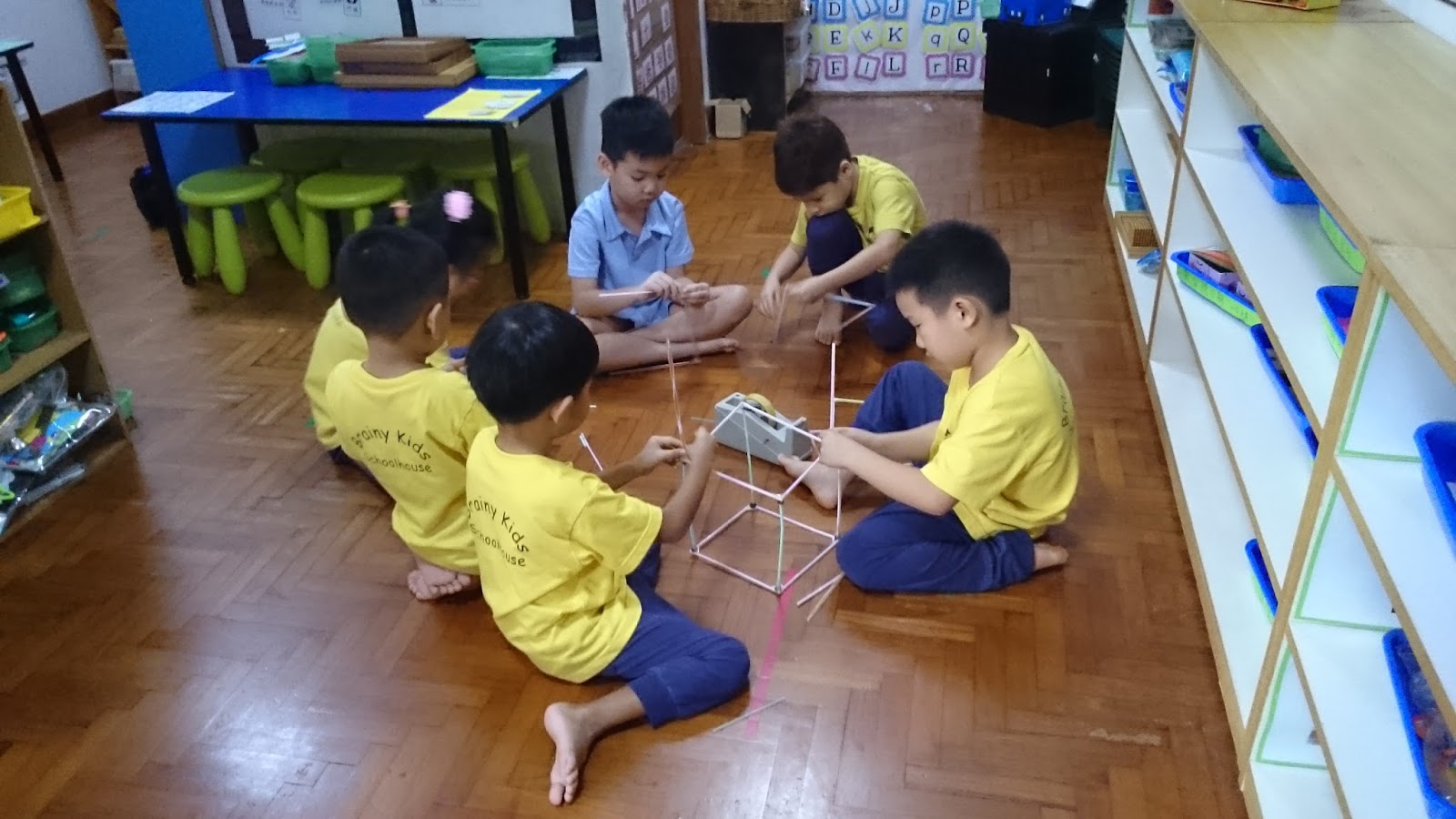
Time to show your power - Teamwork!

 The children will
  • Learn that an object or structure is stable when the forces acting upon it are balanced by the composition of the object or structure itself
  • Discover that unbalanced forces can cause the deformation or collapse of an object or structure
  • Understand that some materials are better than others for constructing a particular object or structure
  • Consider the purpose of the object or structure when choosing materials for construction
The class working together as a team.

Keiran was asking the teacher if his base looked stable.

See Ching working with the scotch-tape dispenser.

All working with full focused.

Everyone was talking and working with great joy!

See Ching with her structure base. Feeling achieved!

Lucas and Enzo feeling proud of their art work.
Andrei and Javier helping and supporting their friend with the structures.

Parents u may encourage your child to try building newspaper towers for height only or to support an object. Have them compare the differences in design between towers designed to hold vertical vs lateral loads, and between towers that are not designed to hold any weight but their own. Enjoy constructing together!

Thursday, February 11, 2016

Sushi Time!

Children had their hands on experience making their own sushi roll. They were shown the ingredients, and demonstrated the steps in creating their sushi roll.
 
Children had fun learning how to roll the sushi as it is something new for them. Look at them, concentrating at work!


This activity allowed children to enhance their eye hand coordination as they learnt to hold and cut the ingredients as well as to roll the sushi into neat rolls. Good job, children!